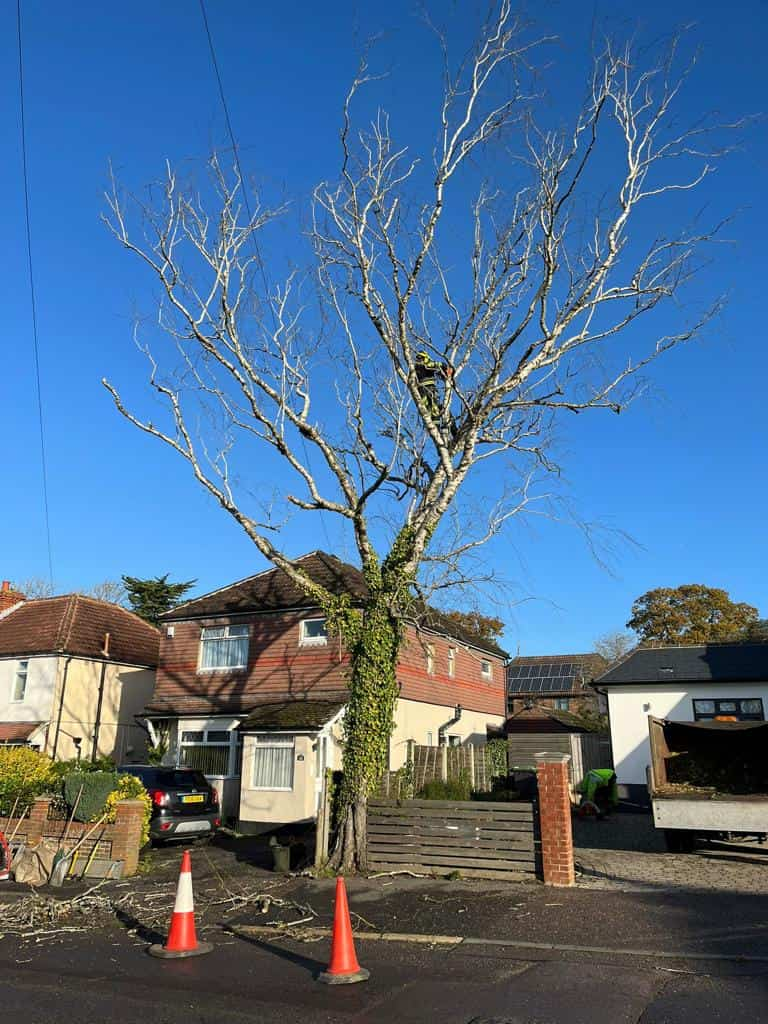
Crown reduction can help manage a tree’s height and spread while retaining its natural structure. When completed correctly, selected branches are shortened back to suitable growth points, with enough healthy foliage left to support the tree.
Incorrect reduction can have the opposite effect. Excessive cutting, poorly positioned cuts and an unbalanced approach may weaken the tree or encourage difficult regrowth. For property owners in Southampton, Hampshire, professional assessment is essential before any significant crown work begins.
The Consequences of Incorrect Tree Reduction
The effect of pruning depends on the tree’s species, age, health and structure. A method suitable for one tree may be inappropriate for another, so the work must be planned around the individual specimen.
Excessive Foliage Removal Can Stress the Tree
Leaves allow a tree to produce the energy required for growth, repair and natural defence. Removing too much of the live crown at once can reduce this capacity considerably.
A severely reduced tree may struggle to respond to wounds or support its remaining branches. Older trees and those already affected by disease, decay or poor growing conditions may be particularly sensitive to excessive pruning.
Large Cuts Can Create Entry Points for Decay
Reducing branches at unsuitable positions can leave large wounds that take a long time to close. Some may never fully occlude, particularly where cuts are made into mature limbs.
Exposed internal wood is more vulnerable to moisture and decay organisms. Over time, deterioration may extend into the branch or main stem, affecting the strength of the surrounding structure.
Weak Regrowth May Develop
After heavy pruning, some trees respond by producing numerous fast-growing shoots near the cuts. This regrowth can appear vigorous, but the new shoots may be more weakly attached than the original branches.
As the shoots become longer and heavier, they may require further management. The result can be a cycle of repeated pruning that becomes more complicated with each intervention.
The Crown Can Become Unbalanced
Removing too much growth from one side can alter the distribution of weight across the tree. This may happen when branches are cut back solely to create clearance without considering the shape of the remaining crown.
A balanced reduction considers the tree from several viewpoints. The objective is to reduce overall dimensions while maintaining a coherent branch structure and natural outline.
Topping Can Damage the Tree’s Structure
Topping involves cutting major branches or stems back to unsuitable points, often leaving blunt stubs. It is different from a properly planned crown reduction, which follows the tree’s existing branching structure.
Topping can create large wounds, stimulate dense regrowth and remove much of the crown’s natural framework. Although the tree becomes smaller immediately, its future structure may become less predictable and more difficult to manage.
Poor Cuts May Prevent Effective Healing
Pruning cuts should be positioned to respect the natural branch collar and the tree’s ability to seal the wound. Cuts made too close to the stem can damage healthy tissue, while long stubs may die back and decay.
The angle and position of each cut matter. Professional tree surgeons select suitable growth points and use techniques intended to preserve the surrounding living tissue.
Previously Sheltered Bark May Become Exposed
Dense foliage can protect stems and branches from direct sunlight and sudden temperature changes. Removing large sections of the crown may expose bark that has not previously received intense sunlight.
Some trees can develop bark damage following abrupt exposure. A proportionate reduction helps retain enough foliage to moderate conditions within the crown.
The Tree’s Natural Appearance Can Be Lost
An incorrectly reduced tree may be left with a flat top, visible stubs or an uneven outline. Dense clusters of new shoots can later make the crown appear congested rather than balanced.
Good reduction work should not simply make the tree smaller. It should preserve a recognisable natural form that suits the species and its position within the garden.
Clearance Problems May Return Quickly
Heavy cutting does not necessarily provide longer-lasting clearance. Strong regrowth may extend towards buildings, roofs, paths or neighbouring branches more quickly than expected.
Carefully selected cuts can manage the relevant limbs while reducing the likelihood of an aggressive response. The work should address the reason for pruning rather than removing growth indiscriminately.
Internal Branches May Be Over-Thinned
Removing too many branches from within the crown can shift foliage towards the ends of the remaining limbs. This may increase leverage and leave branches with insufficient internal growth.
A well-planned reduction retains useful secondary branches and avoids creating long, exposed limbs. This helps preserve a more balanced distribution of foliage and weight.
Existing Defects May Be Overlooked
A tree may contain cracks, cavities, deadwood or weak branch unions that affect how reduction work should be planned. Cutting without first assessing these features can alter forces within the crown in an unhelpful way.
A professional inspection allows priority defects to be identified before work begins. The reduction can then be adapted to the tree’s actual condition.
Corrective Work May Be Limited
It is not always possible to reverse an unsuitable reduction immediately. Removing additional branches could place the tree under further stress, while leaving weak regrowth unmanaged may create future concerns.
Corrective work may need to take place gradually. A tree surgeon can assess what remains and develop a proportionate plan for restoring a more manageable structure where possible.
What Does a Professional Crown Reduction Involve?
A professional reduction begins by establishing why the work is needed and how much growth can reasonably be removed. The tree surgeon then selects individual branches and shortens them back to suitable lateral growth points.
The finished crown should be smaller but balanced, with adequate foliage retained. The exact approach will depend on the tree’s species, condition, age and position.
Conclusion
Incorrect tree reduction can cause excessive stress, decay, weak regrowth and an unbalanced crown. It may also remove the tree’s natural form while creating a need for more frequent future work.
LM Tree Surgery Southampton can assess the tree and plan a proportionate crown reduction based on its condition and surroundings. If you are considering reducing a tree in Southampton, Hampshire, contact our team to arrange a professional assessment.
Call us on: 023 8235 6065
Click here to find out more about LM Tree Surgery Southampton
Click here to complete our contact form and see how we can help with your trees needs.